
Terminology – Definitions and explanations of palaeo-sea-level terminology References – download a spreadsheet of references NOTE: all elevations are quoted relative to LMSL unless otherwise stated.
Characteristics of the global LIG sea level record
Elevations
Veeh (1966) (86) discovered fossil coral reefs throughout the Pacific and Indian Oceans dating to approximately 120 ka preserved at elevations (RSL) of between +2m and +9 m (83). Based on these and other early studies, a LIG global mean sea level (GMSL) of +6 m was widely adopted as default value.
Evidence of prolonged LIG highstands at +4m to +9m (26) to +6.6 to +9.4m (8), +6 to +8m (52) ~+6m (91), and ~+6m (64) have been reported from Western Australia. the Bahamas, South Florida, the Seychelles and Grand Cayman.
Conflicting estimates of LIG GMSL on the low side have been forthcoming from studies in Australia – +2m to +4m (87), the Red Sea – approximately +4m, the Bahamas – +1.2m to + 5.3 m (92); Mallorca – +1.5m to +3m (48) and Cape Verde – +1.5 to +2m.
Anomalous GMSL’s on the high side – of +9 m or greater – tend to be attributed to peak rather than sustained sea levels (76). Alternatively, in these cases, there is often a suspicion that vertical land motion (VLM) has played a role. Increasingly, a VLM component is thought of as the rule rather than the exception.
Regions or countries considered less susceptible to VLM – where LIG palaeo-sea-level research has been focused in recent times – include Bermuda, the Bahamas, Florida, Australia and the Mediterranean. A more detailed discussion of the findings from these localities can be found here.
Sources of meltwater
LIG temperatures by some estimates were only slightly warmer than the preindustrial state. In this case, LIG GMSL peaking significantly above present GMSL is not readily explained. An LIG GMSL of +4m requires loss of mountain glaciers and partial loss of the Greenland ice sheet (26) those in the higher range of +6m to +9m – possibly short-live maxima – require either complete loss of the Greenland ice sheet or its partial loss plus a contribution from the West Antarctic ice sheet (52)(76) , with thermal expansion and mountain glacier melt contributing ~ 0.4 and ~0.3 m respectively (91).
If modest LIG warming compared to present did cause a +6m to +9m rise in sea level, then the sea-level response to ongoing and future warming, today, could be drastic (92). However, these elevations are at the top of a range of estimates which span +2m to +9m. Definitive projections cannot be made because this range may simply reflect imprecise interpretation of sea level indicators and/or contamination by vertical land motion.
Timing
Based on age measurements of emergent coral reefs in the Bahamas, the Red Sea and the Seychelles it has been concluded that LIG GMSL reached its peak of +2 m to + 6m between 132 ka and and 129 ka (85) or even as late as 127 ka (91). It started dropping at about 123 ka (44), falling below present by 122ka (91) and accelerating at 118 ka (44).
This chronology, above, is largely supported by data from LIG coral reefs in Western Australia which record a highstand between 127 ka and 119 ka. However, the evidence suggests that after holding relatively steady at +3 to +4m relative sea level did not fall, but rose to +9.5 m at 118 ka (87).
Red Sea research infers that GSML peaked between 129.5 and 125 ka and then dipped before rising again to a lower peak between 123.5 ka to 118 ka. (91). The elevations, with a high peak preceding a much lower one, not consistent with evidence from other localities. However, the time-span generally corroborates a consensus for LIG highstand of 130 ka to 115 ka (52).
A widely recognised ~15 ka duration for the LIG highstand – whether it includes a single peak or multiple peaks – is nonetheless contradicted by spleothem growth records in Mallorca which witness a highstand spanning as much as 25 ka. Emergent phreatic overgrowths record a sea level rise at 140 ka – 135 ka and, after some fluctuations (up to no higher than +3 m) a sea level fall below present level at close to 110 ka (48).
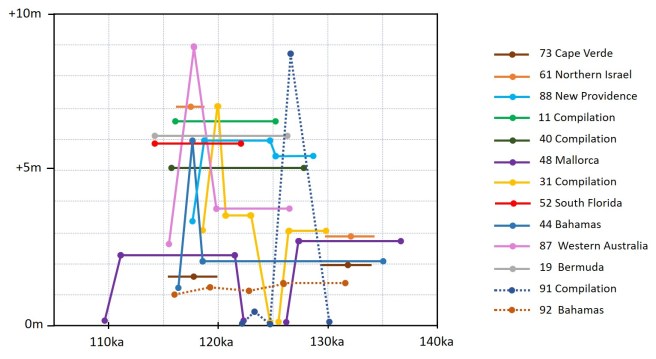
The question of a double-peak
Despite predictions, to the contrary, based on GIA modelling (26), it has been asserted that Bermuda, Bahamas and Australia record the same pattern of sea level change during the last interglacial period (31). This putative shared record can be summarized as follows. Starting with a stable highstand of +2 to +3 m at 130 ka to 125 ka, sea level then fell back to below the present level. In the middle of the LIG it rose again to + 3 m to +4m where it stabilized from ~ 124 ka to 122 ka before a surge to +6m to +9m at ~120ka (31) followed by an abrupt regression.
In Northern Israel a shoreline sequence accurately records RSL which stood at +1 to + 3.5m for most of the MIS5e period but included several sea level regressions (P61). Evidence then suggests that towards the end MIS5e, RSL rose briefly to ~+7m (P61), which is consistent with a late surge cited above.
This double-peak, late-surge scenario, broadly adopted in the 1980s and 1990s is not, however, supported by other studies at Bermuda (19), the Bahamas (85) nor in Florida (52). Several studies at central and western Mediterrenean coastal sites also contradict a second peak that exceeds the first.
On the Spanish coast of the Western Mediterranean (49) and in NE Tunisia (53) + 3 m and +2 m LIG highstands, are respectively, recorded in the form of terraces and sedimentary structures (53). While in nearby Mallorca, radiometric dating of phreatic cave formations indicate sea levels of close to + 3 m from 135 ka to 125 ka. These were reportedly followed by a rapid short-lived sea level regression and then, from 120 ka or even earlier, a second highstand at ~ + 2.5 m, which persisted until 110 ka. (58). This speleothem-based record is consistent with that yielded from a study of emergent coastal deposits on southern Mallorca (59).
Giaccio (2024)(97), Mauz et al (2018)(98), Polyak et al (2018)(97) and Tuccimei et al (2012) (59) concluded, independently, from their spleothem- and sedimentological-based research in Italy, North Africa and Mallorca that while there is some evidence for a late peak (119–115 ka), if it occurred, it did not exceed +3m.
Quaternary marine terraces in the Canary Islands and Sal Island, Cape Verde witness similar sea levels histories (Zazo et al., 2004, 2007). Geomorphological, sedimentological and stratigraphic evidence, at these localities, suggests that two highstands occurred during the LIG. It is reported that sea level reached elevations of ∼ +2 m during the older highstand, and ∼ +1.5 during the younger. (P73).
Citing a compilation of global evidence, Rohling et al (2019) (91) produced an LIG sea level curve which, contradictory to the consensus, comprised a high early peak, lasting from 130 ka to 125 ka and rising to ~+6m (FIgure 13a). This, they attributed almost exclusively to melting of the Antarctic ice sheet. Following the apex at ~127 ka, there was a sea-level regression centred on 125–124 ka, which in turn gave way to a minor rise toward a small peak at or just above 0 m at ~123 ka (91) (see Figure 13a).
Divergence between site specific sea level signals due to overprinting by local tectonic, isostatic and other local influences. (91)
 Bermuda Geology